Autodesk Vault 2017 Implementation Guide
Custom Objects have been in Vault Professional for quite some time, but many people do not know what they are. Kim Hendrix, D3 Technologies, presented a class at Autodesk University 2017 explaining and demonstrating the feature.
Autodesk Vault 2017 Implementation Guide
New Object Security Framework Autodesk Vault Workgroup 2017 and Autodesk Vault Professional 2017 introduce a new security paradigm to provide more control over who can access Vault objects. Previous Vault releases used role-based security to see if a user had general access to the object type. If the user had the correct role, then Vault used an additional single-gate security system. Administrators could use either object-based security or state-based security.
Object-based security was generally derived from folders. State-based security was derived from lifecycle state security rules. This led to problems when an Administrator wanted to use both folder and state-based security. In addition, users with the correct role would only need to be able to see an object in order to make state changes.
Autodesk Vault 2017 Crack
Vault was not limiting state changes based on business lines. For example, if a group of engineers in one location could see what another group of engineers was working on, they could make state changes. More Control Over Security for Specific Business Lines Vault 2017 introduces a dual-gate security model that combines folder security with state security. Users must now have role permission, and combined folder and state-based permissions to access a Vault object. With this new dual-gate security model, administrators can control individual access to a Vault object based on organizational area or business line.
For example, an administrator can make it so that a group has read, write, and delete permissions but certain members of the group do not have some permissions while in various lifecycle states. See for more information. Legacy Security Still Available Customers who prefer the legacy security model or who want to wait before adopting the new dual-gate security model, can still emulate the single-gate security model by selecting Override object-based security in the Definition Security drop-down of the. This option makes it so that every file that is using that lifecycle definition has state security as an override. Workshop manual free download. Updates to Dialogs and Workflows.
The for an object no longer shows role-based security as a security mode. Instead, the following security modes are available:. Object-based security–security is derived from the object settings. This is the default option. State-based security–available when a state-based ACL exists and is combined with object-based security. Overridden security–available when a state-based ACL is overriding object-based security, or when the administrator sets a manual override on the object.
Combine with object-based security–state-based security defined for individual states within this lifecycle definition combine with the object-based security set on the object. In other words, the combined security becomes the effective security for the entity. Override object-based security–state-based security defined for individual states within this lifecycle definition override the object-based security set on the object.
In other words, state-based security becomes the effective security for the entity. Note: Vaults migrated from Vault 2016 or earlier use Override object-based security as the default setting so that legacy (single-gate) security is maintained. However, all new vaults use Combine with object-based as the default security setting, which is a dual-gate security setting. Change this setting at any time to mimic legacy (single-gate) security.
See for more information. Administrators can now control how state security impacts files in a folder in a particular state by selecting on the Security tab for that lifecycle state. In previous releases, only network-based licensing was available.
Vault 2017 now offers two license types: single-user subscription (stand-alone) or multi-user subscription (network). Single-User Subscription license–A single-user subscription license is a stand-alone license that is tied to the machine on which the Vault applications run. The single-user subscription license is available with Vault Workgroup and Vault Professional. Multi-User Subscription License-A multi-user subscription license is a network license that is tied to the Windows account used to run the Vault applications. Only one license is pulled if the applications which require a license are launched from the same machine with the same windows account.
The multi-user subscription license is available with Vault Workgroup, Vault Professional, and Vault Office. In previous releases, it was difficult to identify which CAD files did not have the item data required to create Items and BOMs. Autodesk Vault Professional 2017 makes it easier to identify these files.
Administrators can now restrict users from assigning items to CAD files that do not yet have item data by selecting the Block Assign Item if file has no Item Data option on the dialog. If a user attempts to assign an item to a CAD file without item data, a message displays, informing the user that the action is restricted. This feature is on by default. Users can now create a job that generates a BOM object for selected Inventor files that are missing BOM information by selecting the command on the Actions menu. A job described as Extract Item Data is added to the job queue, where is the CAD file being processed. A new system property is introduced called Item Assignable and is available on the Advanced Find and Customize View dialogs, making it easier to search for and view files based on this property. If a file has Item Data (BOM information), the Item Assignable value is True.
Vault Workgroup 2017 and Vault Professional 2017 now allow properties on a link level between:. two defined custom object entities.
a custom object and a file, folder, or item entity. a folder and a file, folder, or item entity. User-defined properties can be created for these links. In addition, the new linking system allows administrators to import link properties using the Factory.config file so that information about the relationship between two vault objects can be tracked as a property link.
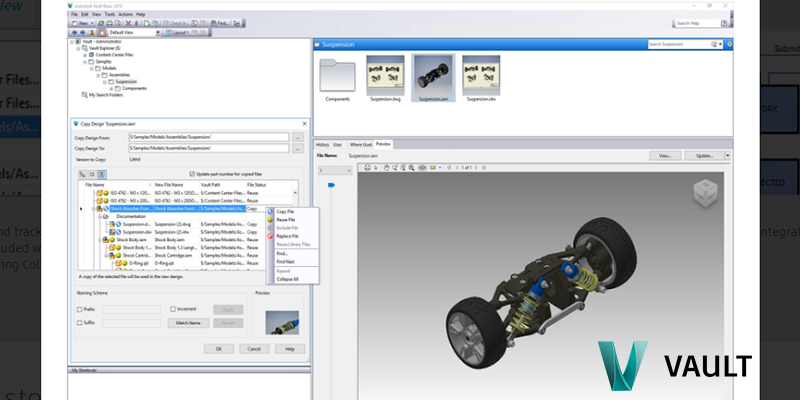
To support this new feature, a new has been created and is visible on the Property Administration interface. Imported Factory property links show this link association as selected. However, the link properties are not accessible via Custom View in the Vault user Interface (lists and tabs). The Administrator needs to create a custom tab to be able to display link properties. New Folder List View in Copy Design Vault Workgroup and Vault Professional 2017 introduce a new folder list view in Copy Design. Users can now set a destination path in the folder panel by manually updating the destination folder path or assign the destination folder by using Find and Replace capabilities to update the folder path string. In addition, users can substitute values, such as the project number, in the folder path by simplifying the new file path in instances where there is a complex rules-based structure, or by individually browsing to folder locations by file.
New Auto-Fix Feature for Certain Pre-checks In an effort to reduce installation issues and administrator interactions, Vault 2017 introduces a new Auto-Fix feature for the and the pre-check. If the system finds an issue with either of these pre-checks during installation, the administrator can click Re-test to have the system attempt to automatically correct the issue. If you prefer to do this manually, you can leave the install screen to perform the changes, but this simple enhancement for common settings issues can help simplify initial installation.
Before you begin your Vault installation, you should prepare for the deployment by examining your environment and gathering data to ensure an optimal installation experience. A Vault implementation can be as simple as installing all components on a single computer, or as complex as installing components on several computers in different locations. The more complex the implementation, the more information there is to consider. The following sections detail information to consider to make the best decisions for your Vault implementation. Microsoft SQL Express Autodesk Vault requires a minimum of Microsoft SQL Express. If your Vault implementation requires more capacity than SQL Express, set up the Vault server using the Standard or Enterprise versions of SQL. If your computer/domain is set up to require strong/complex passwords, you will not be able to use the default SQL SA password used by the Autodesk installer.
Visit for information about setting an appropriate SA password. Check with your IT administrator to learn the requirements for a strong/complex password. Autodesk Vault 2018 installs SQL Express 2012 SP3 using the Network Service account for SQL services. SQL Express 2012 SP3 cannot be installed on a domain controller under a local service account or a network service account.
For security reasons, Microsoft recommends that you do not install SQL Server on a domain controller. Visit to learn more. SQL Failover Clustering Autodesk Vault functions in a SQL failover cluster configuration in which it is unaware of the cluster and does not require reconfiguration of Vault if and when a failover occurs. This is known as the AlwaysOn Failover Cluster Instances (FCI).
More information about this configuration can be found. Before configuring this feature, Windows Server must be configured for. When Vault is used within a SQL failover cluster environment, workflows occurring during a failover may be interrupted and require repeating the workflow.. Network Speed Although network speed is commonly equated to latency, you should also consider bandwidth and throughput. Network speed is an important factor to consider when trying to get the best performance for your Vault implementation. By running tests to measure your latency, bandwidth, and throughput among all of the servers, you can gain an idea of how fast the connections are.
Copy a few large files from one server to another. When performing this test, copy from Server A to Server B and then copy from server B to Server A. Data traveling from one server to another does not always take the same route when traveling back. Expanded Architecture In addition to a traditional multi-site environment configuration, the multi-site architecture can be expanded by using the Autodesk Vault File Server. In this layout, a remote site hosts its filestore locally, similar to a traditional multi-site environment, while directing meta-data traffic to the Autodesk Data Management Server to which it is connected. This configuration can provide considerable performance improvements if the remote site has a poor or slow connection to the SQL server. Replication Replication is the process of copying data from one server to another server usually located in two different physical locations.
This process allows the setup of a Vault environment that has two different locations. Users will not have to spend time downloading large CAD files across their Wide Area Network (WAN) connection. The connected workgroup feature in Autodesk Vault Professional supports the use of multiple database servers using Microsoft SQL merge replication technology. This technology allows the replication of the SQL database at multiple locations. Virtual Environment It is recommended that you allocate the recommended (or higher) system requirements when running Autodesk Vault in virtual environments. As virtual environments can cause unexpected consequences, Autodesk reserves the right to ask that any customer-reported problems be reproduced on a physical machine outside of the VMware environment. For information on certified virtualization vendors and their respective solutions, see Microsoft's products list.
Microsoft's support policy for Microsoft software running in non-Microsoft hardware virtualization software can be found. Microsoft's support policy for Microsoft SQL Server products running in a hardware virtualization environment can be found. Supported Client Language Configurations Any client meeting the following criteria can work with any server of any language meeting the server criteria below. Client language and server language do not need to match.
The Autodesk Vault client is supported on operating systems of the following languages: Brazilian Portuguese, Czech, English, French, German, Hungarian, Italian, Japanese, Korean, Polish, Russian, Simplified Chinese, Spanish, and Traditional Chinese. An English language Vault client is supported on all supported non-English language operating systems. A non-English Vault client must match the language of the operating system.
Vault Basic, Workgroup and Vault Professional are localized into Brazilian Portuguese, Czech, English, French, German, Hungarian, Italian, Japanese, Korean, Polish, Russian, Simplified Chinese, Spanish, and Traditional Chinese. The language of the Autodesk Vault CAD add-in must be the same language as the CAD application. Other Client Language Notes The Vault client does not support runtime language switching.
Vault add-ins do not support the switch of a CAD application's language to a configuration which does not meet the criteria outlined in the section above. An English version of Autodesk Design Review is included in Vault client products for Czech, Hungarian, and Traditional Chinese. An English version of Autodesk DWG TrueView is included in all Vault client products for all languages except Japanese and French. Supported Vault Server Language Configurations Any server meeting the following criteria can work with any client of any language meeting the client criteria above. The Vault Server is supported on operating systems of the following languages: Brazilian Portuguese, Czech, English, French, German, Hungarian, Italian, Japanese, Korean, Polish, Russian, Simplified Chinese, Spanish, and Traditional Chinese. An English language Vault Server is supported on all supported non-English language operating system.
A non-English Vault Server must match the language of the operating system. Any case-insensitive collation and/or language of SQL may be used with any language Vault Server. Migrating from one Language of Vault Server to a different language of Vault Server is only supported if it is to or from an English Language Vault Server.